The cron job that backs up your database every night doesn't care which uptime tool you're running. If it fails, neither StatusCake nor any HTTP monitor will notice. StatusCake has been in the monitoring business since 2012, with server monitoring, page speed tests, and uptime checks from 43 locations across 30 countries. WatchCron started from the other end: cron job monitoring first, then uptime, ports, SSL, domains and blocklists plus status pages. If you're looking for a StatusCake alternative, or trying to decide between the two, this comparison covers what each tool does, where each one leads, and what you'd gain or lose by switching.
What each tool monitors
| Capability | WatchCron | StatusCake |
|---|---|---|
| HTTP / uptime monitoring | Yes | Yes (HTTP, HEAD, TCP, DNS, SMTP, SSH, PING, PUSH) |
| Cron / heartbeat monitoring | Yes (all plans incl. free) | No |
| Port monitoring | Yes (TCP, UDP, DNS, ICMP) | TCP only (via uptime checks) |
| SSL certificate monitoring | Yes | Yes |
| Domain expiration monitoring | Yes (WHOIS-based) | Yes (DNS records + expiry + ownership changes) |
| Blocklist / DNSBL monitoring | Yes | No |
| Server monitoring (CPU/RAM/disk) | No | Yes (Linux agent, 3–10 servers by plan) |
| Page speed monitoring | No | Yes (1–30 tests by plan) |
| Public status pages | Yes (included) | Yes (up to 100 branded pages) |
| Incident management | Yes (standalone workflow) | No |
| Monitoring locations | Multiple regions | 43 locations, 30 countries |
| Check interval (minimum) | 1 minute | 30 seconds (Business plan) |
| Notification channels | 10 | 14+ (email, SMS, Slack, Discord, Telegram, PagerDuty, OpsGenie, Pushover, DataDog, more) |
| Voice call alerts | Yes (Business plan) | No |
| SMS alerts | Included from Pro ($19/mo) | 400–600 credits/mo on paid plans |
| PDF & CSV reports | Yes | Yes (white-label on Business) |
| Free plan | Yes (20 cron checks) | Yes (10 uptime monitors) |
| Team members | 1 / 3 / 10 / unlimited by plan | 1 / 2 / 9 by plan |
| SSO | No | Google SSO (all plans) |
| API | Yes | Yes |
Where StatusCake is the stronger choice
Server monitoring is StatusCake's most distinctive feature. Install a lightweight agent on your Linux server, set thresholds for CPU/RAM/disk usage, and get alerts when any metric crosses the line. If your database server is quietly running out of disk space or a runaway process is eating all available memory, StatusCake catches it at the infrastructure level. WatchCron monitors whether services are reachable and whether jobs are running, but it doesn't have visibility into server internals.
Page speed monitoring tracks load times from multiple global locations and flags performance regressions. If your homepage response time doubles after a deployment, StatusCake records the change and shows you the trend. WatchCron checks whether endpoints respond and validates status codes, but doesn't measure how fast they respond.
Protocol breadth on uptime checks is wider than what most monitoring tools offer. StatusCake supports HTTP, HEAD, TCP, DNS, SMTP, SSH, PING, and PUSH protocols, so you can monitor a mail server's SMTP port, verify SSH accessibility, or check DNS resolution all from the same uptime monitor interface. WatchCron handles HTTP for uptime and covers TCP, UDP, DNS, and ICMP through dedicated port monitors, but doesn't have SMTP or SSH protocol checks built in.
StatusCake runs checks from 43 locations across 30 countries, giving you geographic coverage that most smaller monitoring tools can't match. If you serve users in Southeast Asia, South America, and Europe simultaneously, checking from a single region creates blind spots that StatusCake's distributed infrastructure avoids.
Google SSO on all plans, including the free one, is a convenience that matters more than it sounds. WatchCron offers standard two-factor authentication but no SSO integration. For teams already on Google Workspace, StatusCake removes one more login to manage.
StatusCake also supports 14+ notification integrations including DataDog, OpsGenie plus Pushover and PagerDuty alongside the standard Slack, Discord, and Telegram channels. Their integration ecosystem is deeper than WatchCron's 10 channels, particularly for teams already using enterprise observability stacks.
Where WatchCron fills the gaps StatusCake leaves
The biggest gap in StatusCake is cron job monitoring. StatusCake doesn't offer heartbeat monitoring, so there's no way to know whether your nightly backup ran, whether your queue worker is processing jobs, or whether a scheduled data sync completed on time. WatchCron was built around this use case. Every plan, including the free tier, includes cron monitoring with configurable schedules, grace periods, and alerts when a job misses its expected check-in window.
Blocklist monitoring is another gap. If your mail server's IP lands on a DNSBL, your email deliverability drops and you might not notice until customers start complaining about missing invoices. WatchCron checks major blocklists and alerts you when an IP appears. StatusCake has no equivalent.
Incident management on WatchCron runs as a standalone workflow. Create an incident, post timestamped updates through investigation → identified → monitoring → resolved stages, and notify status page subscribers at each step. StatusCake has status pages, but no structured incident workflow. Their incidents are informational updates, not a managed process.
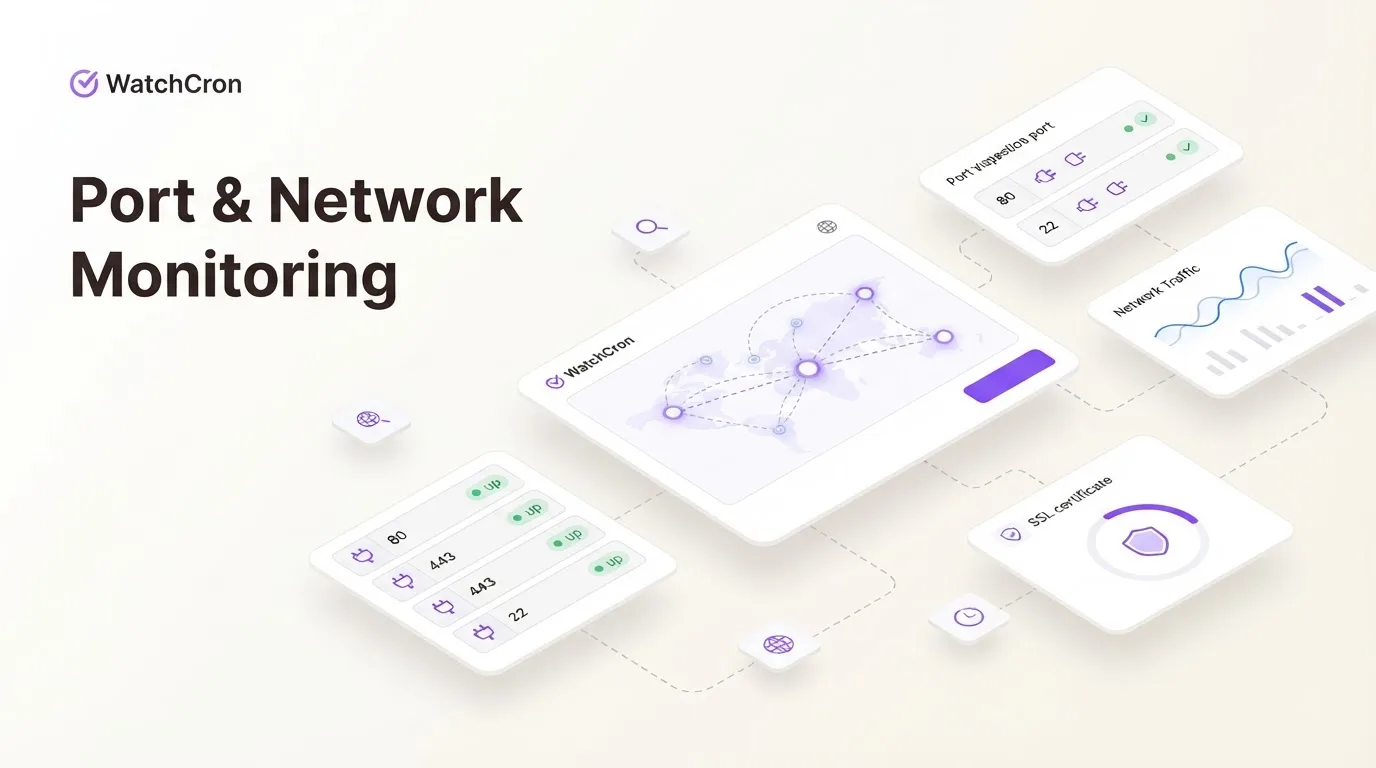
Port monitoring on WatchCron supports UDP, DNS, and ICMP in addition to TCP. If you need to check a game server's UDP port, verify DNS resolution on port 53 with actual DNS queries, or confirm ICMP reachability, WatchCron handles it. StatusCake's port checks are TCP-only through their uptime monitoring interface.
WatchCron's port and domain monitors are unlimited on every plan and don't count against your check limits. StatusCake meters domain monitors (1 on free, 50 on Superior, 120 on Business) and SSL monitors (1 / 50 / 100 by plan). If you manage dozens of domains across client projects, those limits add up. One detail that catches people off guard: StatusCake's SMS alerts run on a credit system (400–600 credits per month depending on plan), and once those credits run out mid-month, SMS stops until the next billing cycle. WatchCron includes SMS on Pro and above without a credit cap.
Uptime reports with PDF and CSV exports are included on all WatchCron plans. StatusCake reserves unbranded reporting for Superior ($24/month) and white-label reporting for Business ($80/month). If you need to hand a client a clean report without third-party branding, WatchCron includes that at a lower price point.
Pricing: established player vs. flat plans
StatusCake's pricing reflects its heritage as an enterprise-oriented platform. WatchCron's pricing reflects a product built for developers and small teams first.
| WatchCron | StatusCake | |
|---|---|---|
| Free tier | 20 cron checks, 1 member, email + webhooks | 10 uptime monitors, 1 user, 5-min intervals |
| Entry paid | Starter — $7/mo, 75 checks, 3 members | Superior — $24.49/mo, 100 monitors, 2 members |
| Mid-tier | Pro — $19/mo, 250 checks, 10 members | Business — $79.99/mo, 300 monitors, 9 members |
| Upper tier | Business — $49/mo, 1,000 checks, unlimited | Enterprise — custom pricing |
| Cron monitoring | All plans | Not available |
| Server monitoring | Not available | 3–10 servers by plan |
| Page speed | Not available | 1–30 tests by plan |
| Port/domain monitors | Unlimited (don't count) | Metered by plan |
| Check interval | 1 minute | 5 min (free) / 1 min (Superior) / 30s (Business) |
| SMS credits | Included from Pro | 0 (free) / 400 / 600 by plan |
| Voice calls | Yes (Business) | No |
| SSO | No | Google SSO (all plans) |
The price difference is significant. WatchCron's Pro plan at $19/month gives you 250 checks, 10 team members, SMS alerts, and unlimited port and domain monitors. StatusCake's closest equivalent, the Superior plan at $24.49/month, gives you 100 uptime monitors, 2 team members, 50 domain monitors, and 50 SSL monitors. For the same $24 you'd spend on StatusCake's entry plan, WatchCron's Pro gives you more checks, more team seats, and cron monitoring that StatusCake doesn't offer at any price.
StatusCake's Business plan at $80/month includes 30-second checks, server monitoring, white-label reporting, and 9 team members. If you need server-level metrics (CPU, RAM, disk) and page speed tracking, that $80 buys capabilities WatchCron doesn't have. If you need cron monitoring, blocklist checks, incident management, and voice call alerts, WatchCron's Business plan at $49/month covers all of those and costs $30 less per month.
The free tiers target different users. StatusCake's free plan gives you 10 uptime monitors with 5-minute intervals, useful for basic website availability checks. WatchCron's free plan gives you 20 cron checks with email and webhook alerts, useful if your primary concern is scheduled tasks. Neither free plan is a full monitoring solution, but they solve different starting problems.
Pricing as of June 2026, from StatusCake's public pricing page.
StatusCake's maturity vs. WatchCron's focus
StatusCake has been around since 2012 and serves over 120,000 customers including enterprises like IBM. That maturity shows in the breadth of their platform: server monitoring, page speed, 43 global locations, 14+ integrations, and Google SSO are features that come from years of building for enterprise customers. If your monitoring needs span infrastructure metrics, page performance, and uptime checks across a global footprint, StatusCake's platform covers more surface area.
WatchCron is a younger, more focused platform. We built it around the monitoring types that most development teams actually set up: cron jobs, uptime, ports, SSL/domain/blocklist checks, with status pages and incident management because monitoring without communication creates its own problems. The trade-off is deliberate. No server agents, no page speed tests, but deeper coverage of scheduled task monitoring and a simpler pricing structure.
For teams that run a stack of scheduled jobs alongside their web services (nightly backups, hourly data syncs, queue workers, report generators), StatusCake leaves a monitoring gap that requires adding a second tool. WatchCron covers both the jobs and the services in one dashboard.
Switching from StatusCake to WatchCron
StatusCake uses HTTP-based uptime checks, so migration means recreating your monitors. No data export needed. If you're evaluating WatchCron as a StatusCake alternative, here's the process.
- Create a WatchCron account and project. Sign up free — 20 cron checks, no card required.
- Recreate your uptime monitors. Add each URL from StatusCake. Set check intervals, expected status codes, and response validation. WatchCron's uptime monitoring covers HTTP/HTTPS endpoints.
- Add cron monitors for your scheduled tasks. This is the main gain over StatusCake. Create a monitor for each cron job, set the schedule as a cron expression or simple interval, and copy the ping URL into your crontab or scheduler. The "Next 5 runs" preview lets you verify the schedule is correct before going live. Now you'll know when jobs stop running, something StatusCake couldn't tell you.
- Set up monitors StatusCake doesn't cover. Add blocklist monitors for mail-sending IPs, SSL and domain expiration monitors, and UDP or ICMP port checks for services beyond HTTP.
- Configure alert channels. WatchCron supports 10 notification channels including email, Slack, Telegram, Discord, Microsoft Teams, SMS (Pro+), and voice calls (Business). If you used DataDog or OpsGenie integrations on StatusCake, note that WatchCron doesn't have those native integrations. Webhooks can bridge the gap in most cases.
- Recreate your status page. Set up a public status page in WatchCron and connect your monitors.
What you'll gain: cron job monitoring, blocklist checks, standalone incident management, multi-protocol port monitoring (UDP, DNS, ICMP), voice call alerts, PDF/CSV report exports, unlimited port and domain monitors, and project-based organization.
What you'll lose: server monitoring (CPU/RAM/disk), page speed tests, 43-location global coverage, 30-second check intervals, Google SSO, DataDog and OpsGenie native integrations, white-label reporting, and SMTP/SSH protocol checks.
WatchCron vs StatusCake: which one fits?
Pick StatusCake if you need server-level infrastructure monitoring alongside uptime checks. CPU, RAM, and disk alerts from an installed agent, page speed tracking from 43 global locations, and 30-second check intervals give StatusCake an edge for teams focused on infrastructure performance and geographic coverage. The deeper integration ecosystem (DataDog, OpsGenie, PagerDuty) also matters if your team runs an enterprise observability stack.
Pick WatchCron if your monitoring includes scheduled tasks. Cron job monitoring, blocklist checks, standalone incident management, and multi-protocol port monitoring with full cron expression support, maintenance windows, and acknowledge-from-email with full cron expression support, maintenance windows, and acknowledge-from-email fill gaps StatusCake doesn't cover, at roughly a third of the price. If your stack runs nightly backups, queue workers, or scheduled data syncs alongside web services, WatchCron handles both in one dashboard without needing a second tool.
The two tools solve different core problems. StatusCake watches your infrastructure from the outside in: are the servers healthy, are the pages loading, are the endpoints responding. WatchCron watches your scheduled work from the inside out: did the job run, did it finish on time. If you need both perspectives, you'll either pick the one that covers your most critical blind spot, or run them side by side.
20 cron checks, uptime monitoring, port and domain monitors. No credit card, no time limit.